Located somewhere in the Wheeling and Lake Erie Railway’s Brewster Locomotive Shop, there is a sign that says : " GP35 LOCOMOTIVE BUILT:1965 BY GENERAL MOTORS (EMD) HORSEPOWER:2500...WEIGHT 266,000LBS. FUEL:2,300 GAL. ...LUBE OIL: 243 GAL. COOLING WATER:275 GAL. ...CYLINDERS 16 WELCOME ABOARD....."
As part of the 1990 sale agreement to the newly created Wheeling and Lake Erie Railway, Norfolk Southern included about 25 locomotives, specifically EMD’s GP35 model. This battalion was made up from mostly former Southern Railroad units. Over time, units underwent rebuilding at Brewster and emerging with Q-Tron microprocessor controls to bring them up modern control standards. Not all units were lucky to receive a rebuild to extend their service life. The un-rebuilt units were called to duty from time to time in traffic surges, otherwise laid-up hoping for a returned call for duty.
Recently, six un-rebuilt GP35 models left the fleet for three SD40-2 models in a sign and trade deal with LTEX. Another GP35 is being kept around for parts, but will leave Wheeling once depleted. The remaining GP35s will soldier on for some years to come. Units are currently being cycled through Brewster for their second rebuild.
I clearly remember the first time I stepped on 2645 and thought how many other railroaders had stepped aboard the battle weary unit. And weary it was indeed. 2645 responded when asked to move some cars by rattling everything on board. 2645 struggled to move cars. After that run, a call was made and another unit was shipped up for us to use........
A picture of the 2645 and the five others going to LTEX
http://www.railpictures.net/viewphoto.php?id=327756&nseq=0
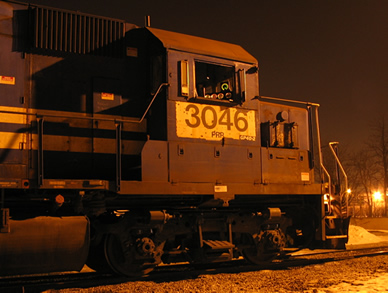
NS GP40-2 3046
Showing posts with label EMD. Show all posts
Showing posts with label EMD. Show all posts
Sunday, July 11, 2010

Sunday, October 25, 2009
“Now let’s have some fun”
After completing an inspection of my train for hand brakes, retainers and closed angle cocks, I stood at the last car in amazement about the size of the train. This was the longest and heaviest train that I had anything to do with. All night in the cab, the engineer and I talked about making it up the hill. We were not sure if we could make it over the hill but wanted to find out at least how far we would make it.
I walked into the cab and informed the engineer to back up when ready as I started to peel off my wet Carhart rain pants and coat.
“You have a lot of faith that I can get this train moving and up over the hill.”
I knew that we had only 40% of making it up the hill. This would be a battle of traction effort and adhesion versus wet rail and the grade. Our duo locomotives for the evening, a GP15-1 leading the second unit, a GP35 would combine for 98,000 pounds of traction effort, 28 EMD cylinders, and 4,000 horse power. The battle against the grade started.
We started the train in run 2 to get us moving quickly. One of the tracks leaving the scrap yard had a slight down-hill grade that gave us some help, but not that much. We crossed the first crossing with no problem and slipped some on the second crossing. We were moving, but it was not the horse power that kept us moving, it was all traction effort. There was no need yet to run the engine at full throttle since this would only cause the traction motors to slip and spin on the wet rail. The train had movement of about 7-8 mph and the only goal was to keep moving. All 31 cars were on the straight grade, engines in run 5 and would soon face an uphill curve in the track. This is where the horse power would come in to provide the power needed to maintain traction effort that would result in us still moving. We enter the curve and started to slip. These two locomotives were couple short hood to short hood which allowed me to see the wheel slip light reflection flashing from the trailing locomotive in my window. Rapidly, we started to loss speed once more cars enter the curve. In a finally assault at about 2 MPH, the engineer notched up the locos only to have them pull some and slip. This lasted only about 1 car length before we stalled in notch 8. We ended up cutting 6 cars off the head end and placing them on a siding that was less than a quarter mile away. While walking back to make the cut, I noticed that the air was filled with a very fine sand dust. This was the result of the sanders sanding the railing, then being crushed by the locomotive wheel and the traction motor blowers blowing it into the air. Pulling the remaining 25 cars was no problem. We soon tied the 25 to the 6 at the side track and headed home.
This night we failed because of adhesion, not horse power. You need power at speed to keep a train moving at track speed. In slow, hard pulls, it comes down to traction effort and adhesion.
Wednesday, October 03, 2007
Norfolk Southern runs a coal train that comes from the Powder River Basin. This train starts somewhere on the BNSF. I'm guessing that it changes hands in Chicago. Somewhere a NS unit with cab signals gets added for the Cleveland Line. This line once belonged to the famous Pennsylvania Railroad. Some trains make there run over the Cleveland Line at track speed while others crawl. Amtrak's Capitol Limited glides along this line at a pretty good clip. There is a coal train that heads west that receives helpers on the rear end. I'm not sure where this train starts at.
Here is a picture of the coal train mentioned above. A trio of EMD SD70 series units (NS SD70M and BNSF SD70MAC) working hard to pull PRB coal upgrade near downtown Cleveland, Ohio.

Here is a picture of the coal train mentioned above. A trio of EMD SD70 series units (NS SD70M and BNSF SD70MAC) working hard to pull PRB coal upgrade near downtown Cleveland, Ohio.

Subscribe to:
Posts (Atom)